




IntelliPaper
Abstract
Piping is one of the important causes of accidents in water conservancy facilities such as embankments and dams. Therefore, it is of great practical significance to study the timely plugging after the occurrence of dike piping. Based on the plugging of pipeline magnetic materials, this paper proposes a new method of plugging piping holes with PMC. Combined with the experimental method, the effects of different ratios of oily and waterborne polyurethane and the amount of magnetic powder on the plugging effect of PMC were investigated. The main results are as follow:(1) Under the same ratio of oily polyurethane and waterborne polyurethane, the more the magnetic content in the mixture, the easier the PMC is adsorbed by the strong magnetic field at the water inflow, and the more the magnetic material and polyurethane capsule are gathered in the water inflow. The comprehensive analysis shows that the magnetic capsule has the best plugging effect on piping when the content of magnetic material is 45g and 60g.(2) In the case of the same amount of magnetic materials, the ratio of oil polyurethane and waterborne polyurethane used in the test is 1:1,1:2,1:3,2:3, respectively. The water inflow curve is basically the same, and the more the proportion of oil polyurethane in the mixed polyurethane grouting fluid, the faster the PMC reacts with water, the less the final water inflow, and the four mixed polyurethane slurry ratios selected in the test can achieve better plugging effect. The research in this paper provides a good theoretical and experimental basis for piping rescue technology and magnetic material plugging in the future.
Explore Digital Article Text
I. INTRODUCTION
With the rapid development of the national economy, flood control and disaster reduction have become the top priority. As of 2019, the number of reservoirs in China has reached nearly 100,000, becoming the country with the largest number of reservoirs in the world [1-5]. Various types of reservoir dams are accompanied by a long history, and often do not have good maintenance, and various problems have emerged one after another [2]. Among them, the piping damage caused by leakage accounts for of the total number of accidents. It can be seen that the research on piping plugging has become very important [6-12].
Grouting and water plugging technology is one of the most common methods to control water inrush disasters . Although polyurethane in traditional grouting materials has a good effect on plugging piping, polyurethane slurry has the characteristics of rapid dispersion, emulsification and expansion when encountering water, which will cause some problems on how polyurethane slurry enters the piping channel . The most commonly used grouting method in the process of engineering piping plugging is the high-pressure grouting method. This method is used to inject polyurethane slurry into the piping channel, and the piping outlet has compressive resistance, which may cause secondary damage to the already sealed hole. Therefore, based on the research of magnetic material plugging, this paper proposes a new type of polyurethane magnetic capsule to plug the piping method, and through the self-designed piping simulation test device, to carry out in-depth research on the plugging mechanism of magnetic capsules.
At present, magnetic materials are not widely used in engineering applications, mainly for structural safety research under magnetic induction. TaeseoKu [18] studied the influence of nanoparticles on grouting performance under water-rich conditions. The results show that the application of nanoparticles can effectively improve the grouting reinforcement performance. Mu et al [19-20] used the piezomagnetic effect to study the force-magnetic relationship model of the interface between steel and reinforced concrete. Zhao et al [21-22] plunged magnetized water into concrete and found that the performance was greatly improved. Some scholars have mixed magnetized steel fibers into concrete for magnetic induction orientation, which greatly enhances the shear strength and flexural stiffness of weak areas of buildings. Liu et al[23] used the attractiveness of ring magnets to magnetic materials and combined with high-strength adhesives to solve the leakage problem of diameter pipelines. Hu et al [24] added the magnetic material to water, and then added the amount of polyvinylpyrrolidone and suspension aid A to make the magnetic material suspend in water. The plugging performance and plugging mechanism of the magnetic material were studied by a self-made plugging simulation device. The results show that the greater the magnetic force of the electromagnet, the better the plugging effect of the magnetic material. The closer the electromagnet is to the outlet of the hole, the more the magnetic material is accumulated, and the better the plugging effect is. It can be seen that the application of magnetic materials in the field of grouting reinforcement and fracture anti-seepage plugging engineering has great development space and research value.
Based on the previous research on magnetic material plugging, this paper proposes to add magnetic materials to polyurethane capsules, and then use the adsorption force of magnets on magnetic materials to achieve the purpose of plugging piping. In order to better study the plugging mechanism of magnetic capsules, a single-tube piping simulation test device was independently designed to explore the effects of different ratios of oily and waterborne polyurethane, and the amount of magnetic powder added on the plugging effect of PMC.
II. MATERIALS AND METHODS
2.1 Experimental material
The polyurethane grouting fluid used in the experiment is mainly hydrophilic (water-soluble) polyurethane and hydrophobic (oil-soluble) polyurethane. The appearance of hydrophilic polyurethane is light yellow transparent liquid, and the appearance of hydrophobic polyurethane is dark brown liquid. The magnetic material is micron spherical magnetic powder with a content of 99% , which has a good magnetization effect and lower cost than nano- magnetic powder. In addition, the test also requires additives, buckets, magnetic rings, transparent acrylic tubes and other reagents and materials, as shown in table 1 below.
Table 1: Experimental drugs and materials used in plugging exponents
| Name | Model |
| Polyurethane slurry | Hydrophilic(water-soluble)、Hydrophobic (oil soluble) polyurethane |
| Magnetic materials | Grain diameter 5-10μm ferriferrous oxide ( $Fe_3O_4$ ) magnetic powder |
| Suspending agent | Sodium silicate |
| Floatation agent | RON's reagent |
| Empty capsule | oo glutinous rice hollow capsule |
| Clear acrylic tube | Outside diameter 25mm、Inner diameter 21mm |
| Plastic bucket | 10L |
| Tank connector 6-point set | External 25 PVC pipe |
| Nanda 703 silicone rubber | Net weight 45g |
| Ru iron boron magnetic ring | Outside diameter 36mm*thickness2.5mm/internal diameter 25.5mm |
2.2 Test instrument
The instruments used in this experiment mainly include: a number of disposable rubber head droppers, a number of 2000ml measuring cylinders, a number of disposable plastic bowls, electronic scales, glass rods, timers, electric agitators, and self-made piping plugging simulation devices.
2.3 Self-made piping plugging simulation devices.
The simulation test device is mainly composed of a bucket, a water tank joint 6-pack (with a PVC ball valve), a transparent acrylic tube, and a Ru Tie B magnetic splicing, as shown in Figure 1. A 35mm round hole is opened on the side wall of the plastic bucket near the bottom of the bucket, and the inner and outer wires in the water-based joint set are connected to the bucket at the opening. Then the outlet of the water tank joint is connected to the transparent acrylic tube, and each interface is sealed with silicone rubber to prevent water leakage. A simple single-tube piping simulation test device is completed by putting 20 Ru Tiepeng strong magnetic rings on the outer wall of the transparent acrylic pipe outlet.
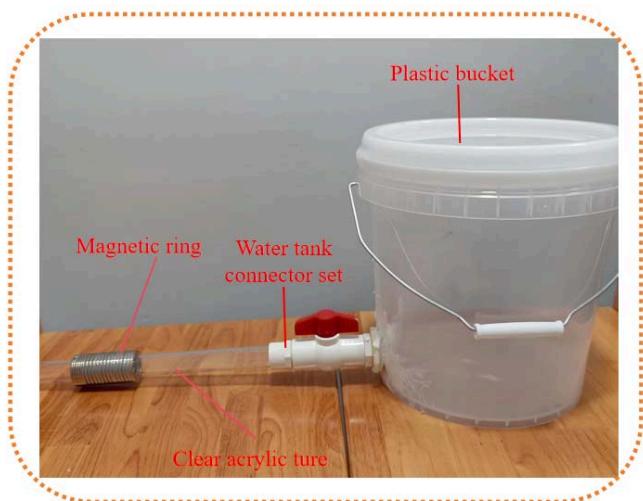 Figure 1: Physical diagram of self-contained pipe plug simulation device
Study on Pipe Plugging Mechanism based on Polyurethane Magnetic Capsules
2.4 Self-made polyurethane magnetic capsules
Waterborne polyurethane and oily polyurethane were mixed in a certain proportion, and then a certain amount of magnetic material was added, and then stirred evenly with a glass rod, and then injected into the hollow capsule using a disposable rubber dropper. PMC as shown in Figure 2 were fabricated.
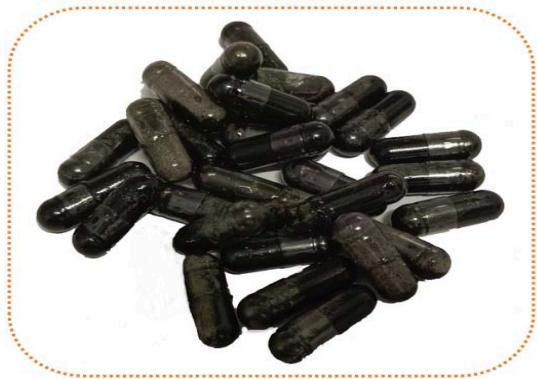 Figure 2: Polyurethane magnetic capsule physical picture
2.5 Test scheme
The amount of magnetic material added in the (PMC) will affect the adsorption effect of the magnetic ring at the outlet of the pipe, and the ratio of the oil in the capsule and the waterborne polyurethane will also directly affect the plugging performance of the pipe. In this paper, the orthogonal experimental design method is used to prepare the oil-based polyurethane and waterborne polyurethane in the ratio of 1:1,1:2,1:3,2:3 of the 500g mixture, respectively, adding 15g, 30g, 45g, 60g of magnetic powder.PMC with different ratios of oil-based polyurethane and waterborne polyurethane and different amounts of magnetic powder were prepared to explore the different ratios of oil-based polyurethane and waterborne polyurethane, and the effect of the amount of magnetic powder on the plugging and piping effect of PMC. The specific parameters are shown in Table 2. Table 2 lists the orthogonal array of 4 factors of 16 experiments in this study, and each factor changes at 4 levels (the name of the experiment is represented by numbers 1~4).
Table 2: Magnetic capsule material ratio
| Trial number | Oil-based polyurethane(g) | Waterborne polyurethane (g) | O/W | Magnetic Material content |
| 1 | 250 | 250 | 1:1 | 15 |
| 2 | 30 | |||
| 3 | 45 | |||
| 4 | 60 | |||
| 5 | 175 | 325 | 1:2 | 15 |
| 6 | 30 | |||
| 7 | 45 | |||
| 8 | 60 | |||
| 9 | 125 | 375 | 1:3 | 15 |
| 10 | 30 | |||
| 11 | 45 | |||
| 12 | 60 | |||
| 13 | 200 | 300 | 2:3 | 15 |
| 14 | 30 | |||
| 15 | 45 | |||
| 16 | 60 |
In this magnetic capsule plugging test, if the amount of magnetic material added in the water is too much, it will also affect the circulation of the PMC in the pipeline, so only 180g of magnetic material is added to 10L of water. The particle size of the magnetic material particles is small and the density is large, and the water solubility is poor. Therefore, the magnetic material is added to the water, and it is easy to accumulate in the water and cannot be stably suspended in the water. In order to make the magnetic powder have good dispersion in water, it is necessary to add 2% concentration of polyvinylpyrrolidone (PVP) and 0.1g suspension aid A [24].
During the test, an electric stirrer was used to stir the PMC in the bucket at a uniform speed, so that it could smoothly enter the water gushing pipeline, and a 2L measuring cylinder was placed at the water gushing port to record the water inflow. By observing the water inflow at the water inlet at different times, the effect of different proportions of PAM on plugging piping was evaluated. A timer is used to record the amount of water gushing every 10 seconds in the first minute, and then every 1 minute until there is no water flowing out of the outlet. In order to ensure the accuracy of the test values, each group of tests was repeated three times, and the average value was taken as the final test result.
III. EXPERIMENTAL RESULTS AND ANALYSES
3.1 Study on the effect of the amount of magnetic material on the PMC plugging piping
When the ratio of oil-based polyurethane grouting material and water-based polyurethane grouting material in 500g mixed polyurethane grouting liquid is 1:1,1:2,1:3 and 2:3 respectively, the PMC prepared when the magnetic material content is 15g, 30g, 45g and 60g respectively are compared and analyzed. The curve of the change of the water inflow at the outlet of the pipe during the test is shown in figure 3.
{"image_source":{"path":"images/a746215d75c6317f11f333a4fef8cf9516308876c519b66d41f3911ce42a0725.jpg"},"content":"","chart_caption":[{"type":"text","content":"(a)Oilypolyurethane:waterbore polyurethane=1:1"}],"chart_footnote":[]} {"image_source":{"path":"images/906d3f05848cbf371b4347dcad2d2beba7b49ad147b644f9ba0a85026485dabd.jpg"},"content":"","chart_caption":[{"type":"text","content":"(b) Oily polyurethane:waterbore polyurethane=1:2"}],"chart_footnote":[]}
{"image_source":{"path":"images/a8fbbf89d0342cb41c8e2ff2e69e39223318338e02090b691a2555403e6a1a38.jpg"},"content":"","chart_caption":[{"type":"text","content":"(c)Oilypolyurethane:waterbore polyurethane=1:3"}],"chart_footnote":[]} {"image_source":{"path":"images/23390e483f2d17fe0fbdedcc6078cfaa6aa7e2238afba9f1800296bcf19fc83b.jpg"},"content":"","chart_caption":[{"type":"text","content":"(d)Oily polyurethane:waterbore polyurethane=2:3"}],"chart_footnote":[]}
Figure 3: Variation curve of water inflow at pipe outlet at the ratio of oily polyurethane and waterborne polyurethane
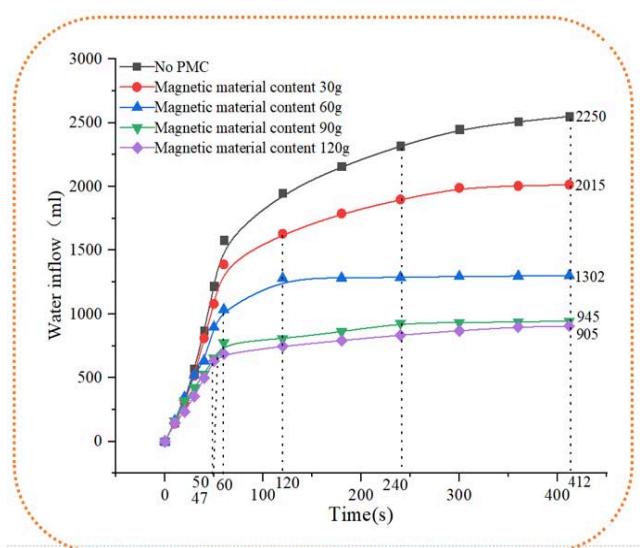
It can be seen from Fig.3 that in the case of only using magnetic materials to block the piping, the water inflow at the piping outlet is as high as 2250ml, and after using the PMC, the water inflow decreases significantly. In the test process of using magnetic materials to block the piping, the magnetic materials enter the piping channel under the action of water flow. Due to the strong magnetic magnetization at the piping outlet, the magnetic materials are gradually adsorbed and accumulated in the pipeline, reaching the effect of plugging the piping. After the magnetic materials are completely blocked, there are still a small amount of water droplets seeping out, and the strong magnetism at the piping outlet is taken away after a certain period of time. At this time, the water leakage is serious, and some magnetic materials in the channel will be lost with the water flow. The channel blocked by PMC has no water seepage after taking away the strong magnetism at the piping outlet, and the plugging effect is good. This is because the magnetic capsule is adsorbed by the strong magnetism at the piping outlet and gathers at the piping outlet, so that the water flow velocity decreases instantaneously. With the erosion of the water flow, the shell of the magnetic capsule melts after a period of time, and the internal mixed polyurethane grouting fluid reacts with water and expands rapidly, enriching the interior of the pipeline and making it reach a better plugging effect. This shows that when plugging the piping, the method of using PMC and magnetic material to block the piping can have better results.
By observing Fig.3 (a), it can be seen that when the amount of magnetic materials is 15g, 30g, 45g, and 60g, the final water inflow at the piping mouth is 2015ml, 1302ml, 945ml, and 905ml, respectively. The addition amount of magnetic material in the mixture of PMC with the ratio of oily polyurethane to waterborne polyurethane of 1:1 also has a certain effect on plugging piping. The water inflow at the piping outlet gradually decreases with the increase of the amount of magnetic material. When the amount of magnetic material is 60g, the water inflow is the least. And the growth rate of water inflow decreases with the increase of the amount of magnetic material added. Observing the curve of water inflow change when the amount of magnetic powder material is 15g, 30g, 45g and 60g respectively, it is found that the growth rate of water inflow has a significant downward trend after 38s, 49s, 60s and 120s respectively, and the time inflection point of the growth rate decreases with the increase of the amount of magnetic material. The increase of the amount of magnetic material is advanced, indicating that the closer the occurrence point is, the faster the water flow rate in the pipeline decreases. This is because when the PVC ball valve is opened, the magnetic material and magnetic capsule suspended in the water enter the piping channel with the water flow, and are strongly magnetically adsorbed at the piping mouth. The more magnetic materials added to the PMC, the easier the strong magnetic adsorption, so that the magnetic material and polyurethane magnetic capsule PMC gather at the piping mouth, the water flow rate decreases rapidly, and the longer the time, the more magnetic materials accumulated in the piping channel, and at the same time, the number of magnetic capsules entering the pipeline will decrease. When the content of magnetic material is 15g, the time inflection point of the growth rate of water inflow is greatly different from that of the other three different contents. Therefore, the number of PMC in the channel with 60g magnetic powder content is less, while the number of PMC with 45g and 60g content is not much different. From the figure, the amount of magnetic materials is 30g, 45g, 60g.
By observing Figure 3 (b), it can be seen that when the ratio of oily polyurethane and waterborne polyurethane is 1:2, the amount of magnetic material is 15g, 30g, 45g and 60g respectively, the PMC plugging test is configured, and the final water inflow at the outlet of the pipe is 2223ml, 1506ml, 1155ml and 1061ml respectively. Compared with the experiment using only magnetic material to block the piping, it can be concluded that the addition of PMC has a better effect on blocking the piping, and the more the amount of magnetic material added, the less the water inflow at the final piping outlet. Comparing and analyzing Fig.3(a) and Fig.3(b), it can be found that in the case of the same amount of magnetic materials, the time inflection point of the decrease in the growth rate of water inflow basically does not change much, and the change law of water inflow is the same. With the increase of the amount of magnetic materials, the growth rate of water inflow at the piping port is lower, which indicates that the ratio of oily polyurethane and waterborne polyurethane has no effect on the number of magnetic capsules entering the piping channel. It also shows that the ratio of mixed polyurethane has no effect on the effect of PMC plugging piping. It can also be seen from Fig.3(b) that when the content of magnetic materials is 45g and 60g, the growth rate of water inflow is relatively slow after the time inflection point, and the water inflow is also less. Compared with Fig.3(a), it can be seen that the ratio of oil-soluble polyurethane to water-soluble polyurethane has a certain influence on the reaction time of polyurethane magnetic materials. Based on the above analysis, it can be seen that when the ratio of oil polyurethane and waterborne polyurethane is 1:2, the PMC prepared with 45g and 60g of magnetic material content has the best rush protection piping effect.
It can be seen from Fig.3(c) that when PMC is used, the water inflow at the final piping outlet is 2292ml, 1615ml, 1275ml and 1112ml respectively when the dosage of magnetic material is 15g, 30g, 45g and 60g respectively, and when the dosage is 60g, the water inflow is the least, indicating that the addition of magnetic material in polyurethane capsule has a certain effect on plugging piping loopholes, and the more the amount of magnetic material added, the less the water inflow at the final piping outlet. By comparing and analyzing Figure 3(a), Figure 3(b) and Figure 3(c), it can be found that in the same magnetic material content and different mixed polyurethane ratio, the final water inflow of the piping mouth is different, which shows that the mixed polyurethane ratio has a certain influence on the final water inflow. Under the condition of the same amount of magnetic material blending, the position of the inflection point at each time does not change much, and the change law of the water inflow growth rate is the same. The growth rate becomes smaller with the increase of time after the time inflection point, and the more the amount of magnetic material is, the less the water inflow is. These indicate that the ratio of the mixed polyurethane has little effect on the strong magnetic adsorption magnetic capsule at the nozzle, and has a small effect on the number of magnetic capsules accumulated in the pipeline. By observing Fig.3(c), after comprehensive analysis, when the ratio of oily polyurethane to waterborne polyurethane is 1:3, it is found that when the amount of magnetic material is 45g and 60g, the plugging time is shorter and the total water inflow is less.
From Figure 3(d), it can be seen that when the magnetic material content is 15g, 30g, 45g and 60g, the time inflection points of the water inflow growth rate are 118s, 59s, 48s and 41s, respectively. The water inflow of the final piping outlet is 2153ml, 1387ml, 1055ml and 1003ml, respectively. When the content is 45g and 60g, the difference of the final water inflow is small, which indicates that when the magnetic material content is greater than 45g, the increase of the magnetic material has little effect on the final water inflow. By comparing and analyzing Figure 3(a)~Figure3 (d), it can be seen that in the four water inflow curve changes, the position of the time inflection point where the water inflow growth rate decreases has little change, and the curve change rule is basically the same. This shows that the mixed polyurethane ratio has a certain influence on the final water inflow, but it has little effect on the effect of the strong magnetic adsorption PMC at the outlet of the pipe. By analyzing the final water inflow of each diagram, it can be concluded that the ratio of oily polyurethane and waterborne polyurethane has a certain influence on the reaction time of polyurethane magnetic materials. Therefore, if the index of water reaction time of PMC is selected, when the ratio of oily polyurethane to waterborne polyurethane is 2:3, and the dosage of magnetic material is 45g and 60g, the magnetic capsule has the best plugging effect on piping.
In summary, the above analysis of the water inflow curve of the four mixed polyurethane ratios shows that the amount of magnetic material in the PMC determines the number of PMC staying in the piping channel when plugging the piping. With the increase of magnetic material admixture, the effect of plugging piping is also gradually enhanced. When the content of magnetic material is 45g and 60g, the magnetic capsule has the best plugging effect on piping. When the amount of magnetic material is more than 45g, it has little effect on the final water inflow of the piping port. This is because the magnetic material will reduce the speed of the PMC to react with water, so the water plugging effect will be weakened.
3.2 Study on the ratio of mixed polyurethane to the plugging piping performance of magnetic capsules
The same content of magnetic materials was added to the mixed polyurethane slurry with the ratio of oily polyurethane to waterborne polyurethane of 1:1,1:2,1:3 and 2:3, respectively. The effects of capsules prepared by mixed polyurethane slurry with different ratios on the plugging of piping were compared and analyzed. The test conditions are the same as those in Section 3.1, and the content of magnetic materials is selected as 15g, 30g, 45g and 60g respectively. The change curve of water inflow at the piping outlet during the test is shown in Fig.4.
{"image_source":{"path":"images/ac8fa464c764160911529d7301adfaf1be86e6fe284814358cc6f1cc21173f60.jpg"},"content":"","chart_caption":[{"type":"text","content":"(a) Magnetic material content 15g"}],"chart_footnote":[]} {"image_source":{"path":"images/4db389d653c84287c8825c6befbfd1df12a04e0bfd4552374232ff1f4dc503aa.jpg"},"content":"","chart_caption":[{"type":"text","content":"(b) Magnetic material content 30g"}],"chart_footnote":[]}
{"image_source":{"path":"images/be0daadb2816a8d53ed6a04a7df335477a21c2472bdbc7ef322aa989b77ccbc8.jpg"},"content":"","chart_caption":[],"chart_footnote":[]} {"image_source":{"path":"images/9848ecf5c9f5447b5045ac95dc7ed17d7e29b7dfbb309a554655a6863f9024bc.jpg"},"content":"","chart_caption":[{"type":"text","content":"(c) Magnetic material content 45g"},{"type":"text","content":"(d) Magnetic material content 60g"},{"type":"text","content":"Fingure 4: Variation curve of water inflow at pipe outlet with different magnetic material content"}],"chart_footnote":[]}
It can be seen from Fig.4 (a) that when the content of magnetic material is 15g, the change trend of the four curves is basically the same. The water inflow of the pipe gushing port increases rapidly before 62s, and the water inflow increases slowly after 62s. The main reason is that before 62s, the PMC and the magnetic material entered the piping channel, the capsule shell did not begin to melt, and the polyurethane did not contact with water to react. After 62s, the capsule shell completely melted, and the mixed polyurethane slurry inside the capsule gradually reacted with water until the reaction was complete. The reaction rate of oil-soluble polyurethane:waterborne polyurethane=1:1>oil-soluble polyurethane:waterborne polyurethane=2:3>oil-soluble polyurethane waterborne polyurethane=1:2>oil-soluble polyurethane:waterborne polyurethane=1:3, the more the proportion of oil-soluble polyurethane, the faster the reaction rate, the less the final water inflow. It can be seen that the four water inflow change curves basically coincide before 62s. This is because after the PVC ball valve is just opened, the water flow is large, and the strong magnetism at the piping mouth is difficult to adsorb the PMC when the magnetic material content is 15g. The magnetic material suspended in the water flow is easily magnetized, gradually accumulated at the channel mouth, and the water flow decreases randomly. At this time, the PMC will stagnate in the channel with the water flow into the channel, and the number is small. After 62 s, the four change curves have little change in water inflow. This is due to the reaction of polyurethane magnetic capsule PMC with water, which has the effect of blocking the channel. Although the PMC with a magnetic material content of 15g has a certain effect on piping plugging loopholes, it takes a long time.
By observing figure 4(b), it can be seen that when the magnetic material content is 30g, the PMC begins to react in the channel. From the change of the rate of the four water inflow curves, the speed of the reaction of the PMC with water is reflected. The earliest water inflow of the curve changes the least, and the reaction speed is the fastest. The speed of the reaction rate is oily polyurethane: waterborne polyurethane =1:1 > oily polyurethane: waterborne polyurethane = 2:3 > oily polyurethane: waterborne polyurethane = 1:2 > oily polyurethane: waterborne polyurethane =1:3. It is concluded that the content of oily polyurethane is proportional to the reaction rate. Comparing Fig.4(a) and Fig.4(b), it can be seen that the effect of PMC plugging piping vulnerability when the magnetic material content is 30g is better than that when the content is 15g. Since the magnetic material content is 30g, the reaction speed is faster, and the number of PMC retained in the channel is also more.
It can be seen from Fig.4(c) that the more the content of oily polyurethane in the PMC, the faster the reaction rate. The reaction rate of these four curves is as follows: polyurethane: waterborne polyurethane = 2:3 > oily polyurethane: waterborne polyurethane = 1:3 > oily polyurethane:
waterborne polyurethane = 1:2 > oily polyurethane: waterborne polyurethane = 1:1. By comparing and analyzing Figure 4(a) ~ Figure 4(c), it can be seen that the reaction speed is the fastest when the magnetic material content is 30g, while the reaction speed slows down when the magnetic material content is 45g. The main reason is that the number of polyurethane magnetic capsule PMC in the channel is very small, which has little effect on the reaction speed. Inside the PMC, the more the mixed polyurethane content, the faster the reaction speed will be.
By observing figure 4(d), it can be seen that the four curves in the figure have the same change trend and the same reaction speed. Therefore, when the content of magnetic material reaches 60g, the ratio of mixed polyurethane in polyurethane magnetic capsule PMC has no effect on the reaction speed of the capsule in water. This is mainly because when the amount of magnetic material is 60g, the content of mixed polyurethane in polyurethane magnetic capsule PMC is relatively small, so the ratio of mixed polyurethane has little effect on its reaction. By comparing and analyzing figure 4(a)~(d), it can be seen that the influence of magnetic material content on the plugging of piping holes by is 30g > 45g > 15g > 60g. In the four pictures, after 62s, the PMC began to react with water. The more the content of magnetic materials in the capsule, the less the water inflow in 62s. This shows that the glutinous rice hollow capsule has the effect of delaying the reaction of mixed polyurethane with water, and the more the content of magnetic materials, the easier it is to be adsorbed by the strong magnetic at the water inlet, and the less time it takes to accumulate the magnetic materials in the channel, and the water inflow decreases rapidly.
In summary, the ratio of mixed polyurethane grouting fluid will affect the reaction rate of PMC in water. In the case of the same amount of magnetic material, the more oil polyurethane content, the faster the reaction rate. According to the size of the reaction speed, it can adapt to the plugging of different water potential of piping holes. If the piping mouth is large and the water potential is large, the PMC with the ratio of oil polyurethane to waterborne polyurethane of 2:3 is selected. If the water potential of the piping port is small and the water flow is slow, the polyurethane magnetic capsule PMC with a ratio of 1:2 of oily polyurethane and waterborne polyurethane with slower reaction speed is selected. Under the action of strong magnetism at the piping port, the magnetic material and PMC are accumulated in the piping channel, so that it can achieve the effect of quickly plugging the piping vulnerability. The PMC with a ratio of 1:1 and 1:3 of oil polyurethane and waterborne polyurethane has a moderate reaction speed, which is suitable for most emergency piping projects.
IV. SUMMARY
Aiming at the problem of piping leakage, based on the plugging of magnetic materials, combined with the use of polyurethane grouting fluid, this paper prepares PMC, and explores the performance of polyurethane magnetic capsule PMC in rushing and protecting piping. The main conclusions are as follows:
In this paper, polyurethane grouting fluid, magnetic material and hollow capsule were selected for the preparation of PMC. The mixed polyurethane grouting fluid and magnetic powder were uniformly mixed, and then the rubber dropper was injected into the meltable starch hollow capsule.
The water inflow of the PMC is less than the water inflow of the magnetic material, which shows that the PMC has a good effect in the process of plugging the piping hole, which can make up for the fact that the magnetic material can not completely block the channel, and there are still water seepage defects in the channel.
In the PMC, different amounts of magnetic materials were added to study the effect of magnetic material content PMC on the plugging effect of piping holes. The test results show that the amount of magnetic material not only affects the effect of strong magnetic adsorption at the piping mouth, but also affects the effect of polyurethane magnetic capsule PMC plugging piping. The more the amount of magnetic material, the better the effect of strong magnetic adsorption, but the less the content of polyurethane in the capsule, the slower the reaction rate with water, and the worse the piping plugging effect. When the content of magnetic material is 45g, the plugging effect is the best, and when the content of magnetic material is greater than or less than 45g, the plugging effect is poor.
In the study of mixed polyurethane grouting liquid ratio of polyurethane magnetic capsule PMC plugging piping performance of the test process, under different magnetic material content, PMC and water reaction time after 62s, indicating that the starch capsule has a certain delay effect on the reaction of polyurethane and water. The higher the content of oily polyurethane in the mixed polyurethane grouting fluid, the faster the reaction rate of the polyurethane magnetic capsule PMC, and the faster the final water inflow. In the case of the same amount of magnetic material, the change trend of the water inflow curve of the PMC prepared by different ratios of mixed polyurethane slurry is basically the same, indicating that the four ratios of oil polyurethane and waterborne polyurethane are selected: 1:1,1:2,1:3,2:3, which has little effect on the effect of plugging piping holes.
Author Contributions: Conceptualization, G.L. and S.L.; Methodology, G.L. and S.L.; Investigation, B.P. and M.W; formal analysis, S.L.; Writing—original draft, S.L. and B.P. All authors have read and agreed to the published version of the manuscript.
Informed Consent Statement: Not applicable.
Data Availability Statement: The research data are included within the article, and further data are available from the corresponding author upon request.
Conflicts of Interest: The authors declare no conflict of interest.
Conflict of Interest
The authors declare no conflict of interest.
Ethical Approval
Not applicable
Data Availability
The datasets used in this study are openly available at [repository link] and the source code is available on GitHub at [GitHub link].
Funding
This work did not receive any external funding.
References
Cite this article
Related Research




Special Issue
Launch a focused special issue to highlight research, emerging trends, and expert insights in your academic field.
