




IntelliPaper
Abstract
The growth of female Islamist movements is part of the inevitable sociopolitical reality that forms part of the emerging political trend in the current global society. Islamist feminism, as it is called, undoubtedly impacts the politics of Indonesia from various angles that are worth further investigation. A thorough examination must be given to its interplay with other Indonesian political and religious bodies since it influences the country's political ecosystem. Understanding their objectives, strategies, and prospective outcomes in Indonesia is critical for both government and civil society as they negotiate Indonesia's changing political landscape. One prominent strategy this movement employs is digital personalization in digital space. Utilizing such a technique can be assessed as both an action and reaction toward the prevalent political discourse in Indonesia. The Islamist feminists have acknowledged insufficient coverage by the mainstream media on issues pertaining to
women's empowerment. Hence, it triggers the political consciousness of this movement to recalibrate the public sentiments toward the topic.
Explore Digital Article Text
I. INTRODUCTION
The feminist religiopolitical movement, also called Islamist feminism, has grown in visibility and popularity in Indonesia, particularly among Muslim women. They can change the country's political environment in many respects that demand deeper understanding because they have only recently achieved substantial traction compared to the traditional, primarily male Islamist movements. Exploring how this movement might affect the current political debate in the most Muslim-dominated country is both urgent and critical.
Islamist feminism could be understood as a reformist ideology that seeks to liberate Muslim women from the androcentric religious praxis. An Iranian-American scholar and a Professor in Sociology, Asef Bayat, argues that Islamist feminism promotes gender equality by blending Islamic principles and the concept of feminism altogether, regardless of their origin: secular, religious, or Western (Bayat, 2007). Through its engagement with the surrounding sociopolitical dynamics and critical dialogue with the broader streams of feminism, it intends to develop a more progressive and vibrant experience for Muslim women. It also aspires to enable Muslim women to pose various critiques of any discriminatory systems that deprive them of their rights. In doing so, Islamist feminism plays a pivotal role in the evolution of Muslim women's movements (Hidayah, 2020).
Since the 1940s, when women like Zaynab al-Ghazali and Nadia Yassine began to play political roles openly within male-dominated communities, the advent of Islamist feminism has been noticed in the Middle East and North Africa (Halverson & Way, 2011). Following that, feminist Muslim groups have been inspired by philosophers such as Amina Wadud Muhsin and Fatima Mernissi (Fikriah & Jakandar, 2018).
In contrast to Islamic feminism, which seeks to challenge the men-centric hermeneutics to integrate feminist discourse within the Islamic paradigm (Sirri, 2020), such ideas are brought a step further to the political sphere by Islamist feminism through activism and advocacy. Islamist feminism actively introduces such conversations to the sociopolitical realm as an alternate perspective of women's roles in Islam beyond the intellectual arguments around theological reinterpretations. Essentially, political activism is the leading property of Islamist feminism.
Because Islamist feminism started to blossom following the fall of Soeharto's semi-authoritarian regime in 1998, around the same time as the surfacing Tarbiyah movement, this political occurrence is not necessarily new (Mutiara, 2023). The women in Indonesia have been cognisant of gender hierarchies in local customs, organizational structures, and sociopolitical institutions. Misconceptions about the status and roles of women have been perpetuated by both religious authorities and the Indonesian government (Parvanova, 2012). It is perhaps the reason behind the growing popularity of the Islamist feminist movement in modern Indonesia, which merits more examination. Its function and involvement comprise problems such as women's dignity and the liberty to express themselves while also attempting to incorporate such themes within the Islamic framework.
II. THE SIGNIFICANCE AND DISTINCTIVENESS OF ISLAMIST FEMINISM IN INDONESIA
Islamist feminism arrived in Indonesia with philosophy, objectives, and tactics that have repercussions for the future of the country. Its adherents see religious ideas intrinsic in Islamist feminism as a tool to infuse ethics in Indonesian politics in order to dismantle the corrupt system and restrengthen law enforcement. It ultimately allows Muslim women, who are frequently undervalued and disregarded in politics, to express their political concerns.
Yayasan Fahmina, Rahima, Nasyiatul Aisyiyah, Fatayat, Alimat, and Jemaah Tarbiyah are among the established Islamist feminist movements in Indonesia. They constantly fight for women's development and entitlement without dismissing the core values of Islam (Mutiara, 2023). Indonesia's two most powerful Islamic organizations, Muhammadiyah and Nadhlatul Ulama (NU), are associated with Rahima, Nasyiatul Aisyiyah, and Fatayat, while Yayasan Fahmina and Alimat claim to be autonomous institutions (Ismah, 2016). On the other hand, the Tarbiyah group belongs to the female section of the Islamist political party Partai Keadilan Sejahtera (PKS). Despite being an Islamist entity, PKS promotes democracy, plurality, protection of human rights, and women's empowerment (Miichi, 2020). Irrespective of whether PKS corroborates these values for electoral purposes, it has successfully increased women's social and political partaking in Indonesia through Jemaah Tarbiyah.
Because their goals are somewhat alike, these Islamist feminist organizations frequently collaborate. Their responsibilities and activities are interwoven because they all fight for comparable purposes. Many Islamist feminist organizations, for example, participate in the non-partisan Indonesia Women's Ulama Congress (Kongres Ulama Perempuan Indonesia/KUPI) quarterly gatherings to discuss problems relevant to gender mainstreaming in Islam. KUPI is a pioneer in convocating female religious leaders in their endeavor to proclaim gender equality as one of the basic principles of Islam (Robinson, 2017).
Sexual abuse, circumcision of female genitals, involuntary marriage, polygamy, divorce, women trafficking, and the well-being of female workers are among the concerns being addressed by Islamist feminists in Indonesia. The proponents of this movement also problematize the Islamic Law imposed upon Indonesian Muslim women on issues such as marriage and divorce as an imported jurisprudence from the Middle Eastern society, thus incompatible with the diverse Indonesian culture and practices (Curnow, 2015).
The Islamist feminists' association of NU and Muhammadiyah magnifies the former's noteworthy in Indonesian politics. The alliance with NU and Muhammadiyah depicts this movement as a dependable actor to rally the public and convince a remarkable fragment of the electorate, adding to the broadening direction, attraction, and fame of Islamist feminism. Islamist feminist organizations have received public approval countless times by accentuating religiopolitical narratives. Thus, they can mold the political pavement to facilitate women's multiple roles in the domestic space, academics, ethics, society, and politics. Beyond the support from NU and Muhammadiyah, the Indonesian Islamist feminist groups owe their success to their charismatic preachers and leaders, many of whom graduated from Islamic religious schools (pesantren) and are currently university lecturers.
Rachel Rinaldo, a writer on Islam and feminism in Indonesia, has highlighted that while Indonesian women have been politically involved throughout their country's history, "visibly pious women" are new on the political scene (Rinaldo, 2013), a pattern seen elsewhere in Muslim Southeast Asia. Rinaldo defines such an occurrence as "pious critical agency," referring to the adeptness to critically and publicly engaging with religious texts. She also contends that not only Islam can be a source of liberation for women, but it is also not fundamentally incompatible with feminism. In fact, they can intersect in new and unanticipated ways (Rinaldo, 2014). Several pieces of literature point out that the secular feminist movements in Indonesia are not detached from the development of Islamic organizations as they are somehow entangled and influence each other (Parahita, 2019).
To illustrate the above, a well-known Muslim scholar and feminist from Indonesia, Lies Marcoes Natsir, was highly appreciated by the two Islamist feminist institutions, Yayasan Fahmina and Mubadalah. id, for her speech on women vis-à-vis Islam during a book launch in 2021. The book Perempuan (Bukan) Sumber Fitnah! (Women are (Not) the Source of Slander!) offers an exegesis of 25 Hadiths often misused to denigrate women (Ashri, 2021). Natsir is a perfect example of someone who maximizes her religious and political influences on gender equality in Islam through research and advocacy.
Etin Anwar is another example of an Islamist feminist spreading her activism in Indonesia and overseas. She is a Professor at Hobart and William Smith Colleges in New York, United States, whose works examine the genealogy of Islamic feminism in Indonesia, the pursuit of gender equality, the philosophical interpretation of gender and self in Islam, and many others. As a scholar, Anwar regularly speaks about her works through public seminars and webinars, partnering with Islamic universities and institutions. Her LinkedIn page is filled with her continuous activism, which has obtained immense appreciation from across the globe. Recently, Etin Anwar delivered a talk in a workshop on "women in Muslim religion and culture" that aimed to discuss women's rights predicaments from both religious and cultural perspectives.
To contrast the agency of liberal and conservative religious actors in Indonesia, Rinaldo distinguishes between "pious critical agency" (which entails the practice of critical interpretation and judgment) and "pious activating agency" (which accepts and promotes literal interpretation). This dichotomy illustrates well the disparities reflected by supporters of women's rights, marriage law reform, and associated concerns on the one side and supporters of gender hierarchy, polygamy, and—in some cases—state-imposed Islamic law on the other (Schröter, 2013). Even when key concerns affecting women's legal rights and gender equality are at stake, contemporary forms of religious engagement are obviously helping to strengthen women's social and political activism (Atkinson, 2019).
III. PERSONALIZATION OF POLITICS: A THEORETICAL STANDPOINT BEHIND EFFECTIVE POLITICAL OUTREACH
John B. Thompson, a Professor of Sociology at the University of Cambridge, mentioned in his book The Media and Modernity: A Social Theory of the Media that one of the most influential themes of political communication is what he referred to as the personalization of politics (Thompson, 1995). Following his book, many scholars further developed and contextualized this phenomenon in different political and social settings.
This paper adopts the definition of personalization of politics by Gideon Rahat and Tamir Sheafer in their co-written article explaining the half-century evolution of Israeli politics. According to them, political personalization is a process in which the individual actors gain more political weight over time while the axis of the political group declines. It occurred as a reaction to the societal changes at that time, including the deterioration of social stratification and advancing technological advancement in communication. Such factors have contributed to the shift in public perception of political parties, causing the latter to lose control over political communications with potential voters (Rahat & Sheafer, 2007).
As voters pay much attention to individual political figures instead of their political parties, the magnitude of political personalization negatively impacts the party's political identity. For this reason, political parties reconsidered operating backstage so that individual representatives could triumph over the public sentiments through personalizing politics. Such mutual symbiosis amplifies the substance of the political figure while maintaining a good share of representatives for the party.
An example of personalization of politics in Southeast Asia is the Malaysian former Prime Minister Mahathir Mohamad. The individual branding of Mahathir had a vital role in positioning himself against the other contenders in the 2018 general election. Mahathir, who was already a familiar figure for the Malaysians, leveraged his prominence as a veteran politician and his mastery to connect with voters on an individual level. His unexpected victory invited a number of empirical questions about why some unfavorable regimes stay in power, which, to a large extent, is explained by the plausibility of the personalization of politics as a vital tool to appeal to the masses (Abdullah, 2019).
Rodrigo Duterte's landslide victory in the 2016 Philippines presidential election is another good example of a leader's ability to connect with voters through a strong and decisive portrayal of himself as someone who promised betterment for the country. This construction of political image by Duterte had triumphantly outweighed his controversial and unorthodox campaign style. Furthermore, it placed his political party behind his personal brand and image. A survey done in 2020 revealed that the supporters of Duterte had made up their electoral attitude far earlier than those of other candidates (Sinpeng et al., 2020). Within the digital space, Duterte's fans were not interested in more information about Duterte and instead logged on to advocate for him and undermine his critics.
The present leader of Indonesia, Joko Widodo, also known as Jokowi, also capitalized on the personalization of politics. Prior to his appointment as president, Jokowi was a relatively unrecognized figure in Indonesian politics. He then built his image as a humble, transparent leader who could relate to commoners' daily struggles. He likes to crack jokes, does not hesitate to make physical contact with anyone, and brightens the atmosphere with his cheerful demeanor (Putra et al., 2020). In contrast with many Indonesian political figures seen as rigid and distant, the portrayal of Jokowi strongly carries the sentiments of populism and flexibility.
These are several instances of how the personalization of politics has been applied by many political figures. It has become a frequent phenomenon in the region and beyond, where a heavy reliance is given on personal image to gain political trust and popularity. A similar strategy has been utilized by the feminist religiopolitical movement in Indonesia to intensify their political outreach. More than just an ordinary image-building conducted within a physical space and later publicized by the mainstream media, the political personalization process of this movement is primarily carried out through cyberspace, maximizing the role of social media in providing a convenient platform for political interaction that transcends the physical territory and boundary.
IV. DIGITAL PERSONALIZATION OF ISLAMIST FEMINISTS IN INDONESIA
In the age where cyber connectivity has become an integral part of life, political personalization involves the creation of intimate relations between political actors and voters by leveraging social media's interface and affordability. It requires consistent image-building for the key political representatives. The process encompasses multifaceted aspects of their lives, including lifestyle, sociopolitical activities, personality, and upheld moral values. Some aspects may be emphasized more than others, depending on the kind of image a political figure requires to build in order to control public opinion.
Social media, including Facebook, Twitter, Instagram, and YouTube, is one channel vastly used by many politicians in Indonesia for their political outreach. There are three central motives for using social media in politics (Enli & Skogerbø, 2013). The first is to market, meaning political figures use them to heighten the public exposure of their political influence. The second is to mobilize, creating online engagements and turning them into actual actions. The third is to converse, where dialogues with the followers take place digitally, creating a sense of connectivity between them.
Religion has been proven potent for acquiring political objectives when employed in personalization. Islam is used by many women in Indonesia to obtain political influence. Using Islam in the political personalization by women's political figures is undoubtedly effective in Indonesia, not only because the majority of its population is Muslim but also, more than just a religion, Islam has been part of the culture and daily practice for the Indonesian Muslims. Having an Islamic image through observances, appearance, and lifestyle grants the political figures an automatic 'righteousness' that will enhance their public acceptance. The followers see the constructed religious identity as an ideal guidance to elevate their religiousness and be better Muslims (Nisa, 2018).
Correspondingly, the Islamist feminist movements in Indonesia benefit from using social media for their political outreach. Muslim women embracing this movement cleverly fuse Islamic godliness and personalization to create "Islamic personalization" as an effective method for political campaigns. The predominant motive fuelling the use of Islamic personalization in digital political activities is to win the hearts of netizens by constructing a piety image of the political figure to attract more public support from the followers (Darwin & Haryanto, 2021). Applying piety in digital politics significantly augments politicians' popularity.
Social media and Islamic piety are two primary components that shape Islamic personalization in Indonesia. The amalgamation of the two has successfully increased Muslim women's participation and representation in Indonesian politics. The case study of the regional election in Aceh in 2019 is an excellent reference for the discussions (Darwin & Haryanto, 2021), whereby an involvement in political and religious activism, along with social media advocacy, was among the criteria that women must have to be eligible as regional representatives (Kurniawan, 2018).
A higher level of Islamic personalization in social media by the political figure stimulates positive responses from the followers. In the case of Islamist feminists, religious personalization expands the media outreach for female Muslim candidates to compete politically. This is due to the fact that social media is a significant part of voters' daily lives (Yarchi & Samuel-Azran, 2018). Therefore, the incline of Muslim women's political outreach through social media positively affects their electability and eventually improves their quantity as political representatives. Islamic personalization clearly encourages political participation for Muslim women in electoral campaigns, as well as their representation in the parliament.
The women from the Islamist feminist group mainly use two methods in constructing Islamic personalization on social media. The first is by accentuating femininity as a juxtaposition to gender stereotyping (McGregor et al., 2017). Another method is to insert gender issues currently existing in society into the Islamic framework as something the community needs to fight for instead of perpetuating the patriarchal hermeneutical practice. In other words, female political influencers promote the conquest of gender equality, showing its ostensible feasibility in fitting into the Islamic framework.
The previously mentioned Lies Marcoes Natsir has been working to infiltrate gender-just issues into Islam, such as reframing the Indonesian societal viewpoints on female circumcision and domestic violence, as well as delinking the concept of piousness with headscarves (hijab) ("Lies Marcoes Natsir Connects Islam and Gender Equality through Research and Advocacy," 2023). Regarding hijab as a symbol of religious superiority, many Muslim women in Indonesia have unfortunately experienced harassment due to no longer veiling. Expressions of sadness, disappointment, and even rage were thrown through comments on social media at these women, who were judged for "toying with Islam" (Yolandasari, 2021). This is one of the areas Natsir tries to overcome. Back in the 1990s, she also spoke about the importance of Indonesian pesantren to understand women's rights concerning reproductive and sexual health (Sciortino et al., 1996). Even at 65, her passion for defending women's rights is still alive through activism on the ground and on social media.
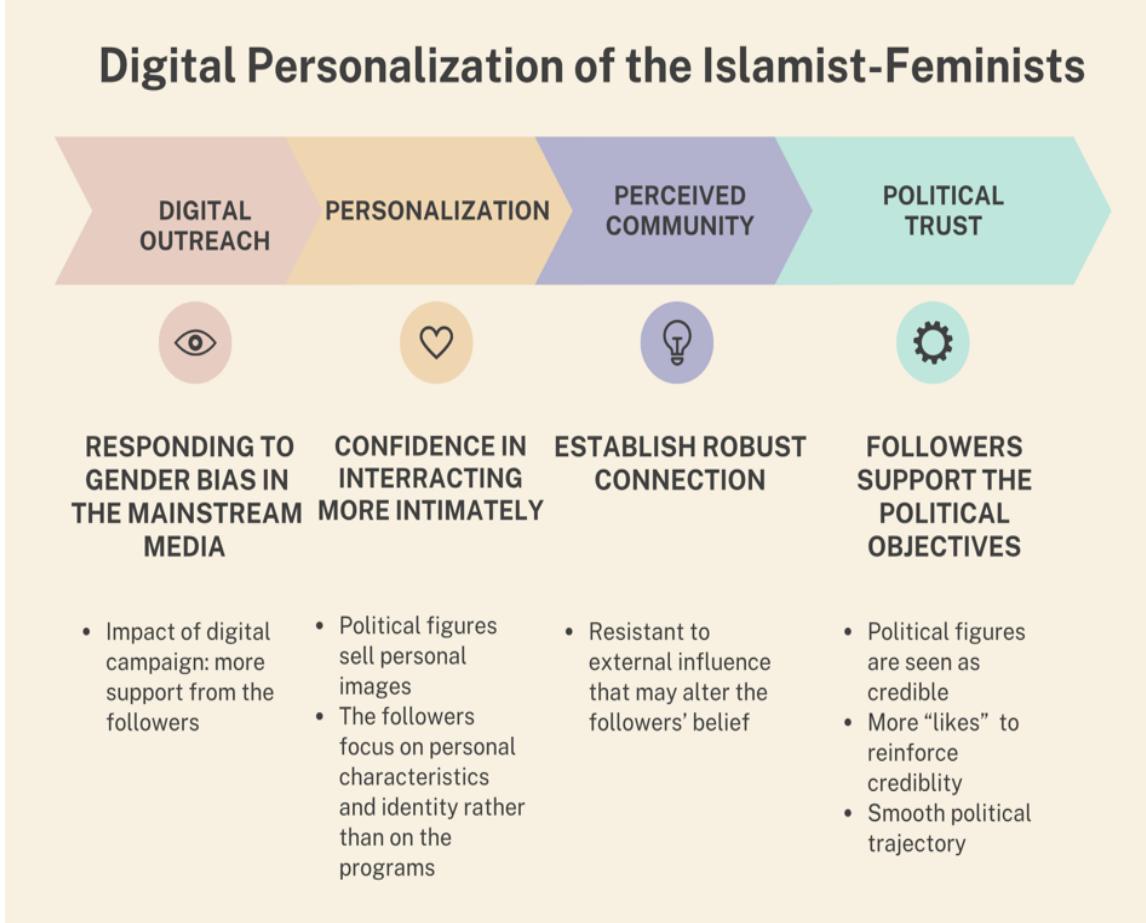
The digital conquest of gender equality by Islamist feminists can be perceived as a response to gender bias existing in the mainstream media (Kim, 2012). Media sexism in political discourse is discernible from the distinct portrayal of men and women, where the former possess a good impression for being "more suitable" to deal with political, economic, and national security issues, while the latter, with physical outlook, lifestyle, and family (Haraldsson & Wängnerud, 2019).
A study done in 2019 reported that digital feminism activists have the irrefutable capacity to mobilize young Indonesian women in the circle of feminists in Jakarta, including those belonging to the Islamist network (Parahita, 2019). Digital outreach by Islamist feminists is one of the best routes of political trajectory because it operates toward building up political trust from the followers, which will help ensure a smooth political career for the political figures. Political campaigns through digital outreach notably impact gaining support from the followers of the political figures. Digital support is indicated by the amount of "likes," positive comments on the posts, and the growth in the number of followers on the social media page. A Professor of Communication who is also an affiliate faculty in Religious Studies at Texas A&M University, Heidi A Campbell, introduced a concept of 'algorithmic-based authority' (Campbell, 2021), whereby those with the most "likes" and followers are regarded as holding the most authoritative quality. This causes the search engines to determine and tell the public who are considered "credible voices" based on the algorithm.
The incline in digital support strengthens the political personalization of Islamist feminists by boosting their confidence in interacting more intimately, albeit virtually, with their followers. At this juncture, the political figures sell personal images, such as individual characteristics and identity, rather than relevant political programs. This is the best point to exhibit their personalized attributes, as the followers have anchored their focus on personal features related to emotional, non-political content.
Followers' preoccupation with subjective elements of the political figures allows Islamist feminists to establish a robust connection with the digital community that transcends to real-life approval from the former to the latter. A "perceived community" phenomenon is formed, whereby followers feel they belong to the same group fighting for the same cause. The followers will also consider the political figures as conduits for their political needs, the warlords of the battle. This perception creates a solid bond between the politicians and their followers. Such a bond is imperative in producing a kind of ideological resistance for the followers, preventing them from shifting their political beliefs amidst external influence.
The flow of digital outreach concerning political personalization within the context of Islamist feminism can be observed from the following diagram.
What goes simultaneously, yet almost unnoticed, within the process of bond creation is an incidental avenue of political 'indoctrination' by the Islamist feminists to the followers. The success of this process is contingent on the effectiveness of politicians-followers rapport-building and the 'marketing' of the former. Apart from the number of "likes" and followers, the outcome of political 'indoctrination' can also be measured by how easily a political figure mobilizes her voters.
It is also interesting to discover that aside from religion, women's political personalization is almost always more effective than men's as they take advantage of gender issues in their campaigns while concomitantly displaying themselves as part of marginalized and underrepresented groups (Jacobs & Spierings, 2016). Another reason for its effectiveness involves the counterforce to women's lack of political representation. Data on the Indonesian 2019 election unveiled the percentage of women elected to Indonesia's national parliament, amounting only to of the total seats (Aspinall et al., 2021).
V. INSTAGRAM AS THE MOST PREFERRED POLITICAL CHANNEL
The proselytization (da'wa) by Islamist feminist groups in Indonesia was traditionally conducted within physical spaces. However, the religious gathering prohibitions during the COVID-19 pandemic have pushed them to solve social proximity restrictions. It appears that the restrictions have affected the female religious groups much more than their male counterparts, as women in Indonesia are generally more active in attending religious gatherings than men (Nisa, 2021). They then tried to relegitimize their agency through an online presence, countering the narratives of the conservative Muslims who reinforced their online activism during the same period.
The digital activism of Islamist feminists received a warm welcome from many Muslim women in Indonesia, specifically during the complex epoch of the coronavirus. Indeed, we can see the emergence of virtual religious communities worldwide during that period (Parish, 2020). It seems plausible that COVID-19 catalyzed the thriving of digital Islamism since it naturally encouraged people to turn to religion and religious authorities for guidance and support (Nisa & Saenong, 2022). For many Indonesian women, female religious leaders are significant since the country has long seen the feminization of the Muslim audience in religious gatherings, lessons, and events (Millie, 2017).
Thereafter, post-pandemic Islamist feminism is repeatedly found in cyberspace, represented by organizations and individuals. Among diverse channels, Instagram is the most used by Islamist feminists in Indonesia to propagate the synergy of Islam and modernism by reaffirming Islamic values on the issues of the power imbalance between men and women. According to data from "Digital 2019 Indonesia," Instagram is Indonesia's most preferred social media platform, with over 60 million users (Beta, 2019). Instagram's various innovations and functionalities are regarded as the new medium for asserting power, authority, and discourse in a patriarchal system (Alatas & Sutanto, 2019).
Kalis Mardiasih is an example of an Indonesian Islamist feminist advocating on Instagram through her account @kalis.mardiasih. As a writer and activist from NU (Andira, 2020), she has published some works on Islam and gender equality and is an activist on @muslimahfeminis, an Instagram page for Muslim women who claim to "strongly believe in the justice of Islam." As of September 2023, Mardiasih has nearly 185,000 Instagram followers. She once collaborated with an Indonesian secular feminist group, Jakarta Feminist, to raise awareness of child grooming risks and harms.
A Professor of Islamic Communication and Broadcasting, Alimatul Qibtiyah, is another example of an Indonesian feminist active on Instagram. Heading several important positions under Muhammadiyah (Rudiana, 2019), she frequently engages in Islamist feminism at the conferences assembled by Muhammadiyah. She has written numerous scholarly works on mapping the understanding of gender issues in Islam, preventing sexual violence for women, feminist identity and its Islamic conceptualization, monogamy versus polygamy, as well as the role of Muslim women in preventing violent extremism. Her Instagram posts mostly consist of public invitations to her seminars, live podcasts, and book launchings – all revolving around addressing gender inequality faced by Muslim women in Indonesia.
Examples of active Islamist feminist groups on social media are Mubadalah Indonesia, Muslimah Feminist, and Cherbon Feminist, with 43,000, 9,200, and 4,300 account followers, respectively. Through visual content, such as photos and captions, they aim to convince the public that feminism and Islamism could move parallelly in the same direction. The level of activism is also elevated through online protests and petitions. Their primary concerns include contesting the perspectives on polygamy and sexual abuse. Issues on justice, equality, education for women, and gender-based discrimination are also covered in their digital campaigns. Through their social media posts, they introduce alternative interpretations to challenge patriarchal control in Islamic religious texts, i.e., the al-Qur'an and Hadiths. They demand that the situation of women be negotiated within the existing patriarchal rule, which often employs Islamic myths to stifle the acts of Muslim women in Indonesia (Rifani & Tambunan, 2020).
VI. CHALLENGES FOR INDONESIAN ISLAMIST FEMINISTS
Although this may sound appealing to many Muslim women, Islamist feminism has the capability to spark sectarian strife among Indonesian Muslims since its ideology may appear too progressive, if not heretical, for many male-dominated Islamist groups. One of the complicating factors in the discussion of feminism in Indonesia is the presumption that feminist ideology is not rooted in Indonesian society and is rather a product of the Western school of thought (Arivia & Subono, 2017). On top of that, the extant hardline Islamist narratives in Indonesia promote patriarchy, conservative attire, polygamy, and underage marriage (Holmes & Fransen, 2021). For them, any debate on these topics equals an attack on Islam because they believe that women's roles have already been predetermined under Islamic principles (Violent Extremism and Insurgency in Indonesia: A Risk Assessment, 2013).
Many universities in Indonesia still embrace a male-centric approach to academic teaching and pedagogical training. They consider integrating the feminist perspective with Islam a mistake in developing epistemology since feminism is viewed as a liberalization in Islam, a root of secularization, and a threat to the purity of Islamic jurisprudence (Sumadi, 2017). They also believe that the feminist perception of al-Qur'an as misogynistic perfectly exemplifies Western orientalism, which is defined as a Western European (and American) system of thought and attitude that brought the non-Western "Other" into representation "geographically, culturally, and morally" (Wilson & Gabriel, 2021) to justify Western political and intellectual hegemony.
Furthermore, Islamist feminism may face opposition from conservative female Islamist groups that adhere to patriarchal interpretations of women's roles and obligations. Conservative Islamic groups and activists in Indonesia have successfully exploited online venues, mainly social media, to spread narratives promoting an orthodox interpretation of Islam restricting female equality. Instagram groups @indonesia tanpafeminis.id(@indonesiawithoutfeminist.id), @lawanfeminisme (@fightfeminism), and @thisisgender unequivocally reject feminism and its hybrid ideologies seen as counterintuitive to Islam (Qomariyah & Triyono, 2019). Using the jargon #Uninstallfeminism and #antifeminism in their digital campaigns, they support patriarchal traditions using gender-biased religious tenets.
A study done in 2021 by some scholars from the Department of Communication and Information, University of Padjadjaran in Indonesia, reveals that the anti-feminist movements on Instagram are not free from religiopolitical agendas (Maryani et al., 2021). For instance, they incessantly persuaded the public to reject the Sexual Violence Eradication Bill (Undang-undang Antikekerasan Seksual) proposed by the legislative Indonesian People's Representative Council (Dewan Perwakilan Nasional/DPR) for the reason that it also safeguards the lesbian, gay, bisexual, transgender, and queer (LGBTQ) individuals whom they register as blasphemous.
It is also crucial to note that the effectiveness of social media in assisting Islamist feminist groups has some limitations. First, the digital outreach will not affect people who are not following the social media pages of the political figures. Moreover, the countercampaign similarly done in social media by the political opponents could undermine the credibility of the political figures. Lastly, the envisioned version of the political figures may not be achieved during the physical encounter with the followers, leading to the depersonalization of politics, consequently drawing the latter away from the former.
VII. CONCLUSION
The rise of Islamist feminism in Indonesia has definitely impacted Indonesia's political landscape through the slow and steady infiltration of its ideology into the current sociopolitical discourse. The Islamist feminist reformist ideology is manifested in its enthusiasm to empower Muslim women by challenging the androcentric religious traditions through the inclusion of feminist concepts in Islam as an effort to widen their sociopolitical space that is otherwise almost non-existent in the protracted patriarchal structure.
Islamist feminism in Indonesia has been inspired by the same movement that started much earlier in the Middle East, even though both might experience different reception due to distinct sociocultural demography and the degree of pluralism between the two. Over time, the feminist Muslim thinkers in Indonesia have metamorphosized into political agents who actively advocate gender issues in the political sphere while simultaneously ensuring the compatibility of such ideas with Islam.
To assist them in gaining political objectives, the Islamist feminists in Indonesia adopt the method of political personalization in social media, particularly Instagram, where they build personal connections with their followers by building a sense of community. The process involves the construction of a piety image, which is highly appealing to Indonesia's predominantly Muslim population. Additionally, Indonesia's lack of women's political participation has birthed a strong sentiment from the ground to resist the system, craving for gender equality and women's emancipation. Positioning themselves as an underrepresented and marginalized group in Indonesia, coupled with the use of the digital platform, has become an effective formula for Islamist feminists to convey political ideas and organize the masses.
The digital personalization of Islamist feminists in Indonesia is significant in reshaping mainstream politics by opposing the current gender norms deemed outdated and irrelevant. The insertion of religious values in digital outreach is one of the unique features of this movement. Despite the challenges faced by the Islamist feminist movement in Indonesia, their contribution to the evolution of Indonesian politics has been foreseen, recognized, and acknowledged. A tremendous portion of Indonesian society perceives Islamist feminists as captivating because, beyond politics, they also address the everyday problems faced by many Indonesian women, such as gender discrimination, sexism, abuse, and coercion. Therefore, the magnitude of
Islamist feminism should not be underestimated, for its rapid expansion and popularity indicate a promising place in Indonesian society.
Conflict of Interest
The authors declare no conflict of interest.
Ethical Approval
Not applicable
Data Availability
The datasets used in this study are openly available at [repository link] and the source code is available on GitHub at [GitHub link].
Funding
This work did not receive any external funding.
References
Cite this article
Related Research



Special Issue
Launch a focused special issue to highlight research, emerging trends, and expert insights in your academic field.
