




IntelliPaper
Abstract
Solar Tracking (ST) is employed to maximize output power due to the nonlinear characteristics of renewable energy sources. Sunlight is considered the most reliable traditional source of energy when energy emergencies arise. First, we present some basic characteristics of the motor in the form of Tables and Figures. Solar panel tracking is, therefore, necessary to enhance their efficiency. In this article, we present the sensor based viz. STM32 microcontroller has been implemented in real-time using the PV arrays. In addition, we did an analysis of stateof-the-art reviews of solar photo-voltaic systems for this research article. Researchers have developed sensor-based techniques to improve renewable energy systems. This technique performs better than other traditional methods.
Explore Digital Article Text
I. INTRODUCTION
The demand for alternative energy sources has increased significantly due to environmental concerns and rising oil prices. Studies have been carried out in the last decade on alternative sources of energy and their applications. Renewable energy has a number of applications that make it competitive. Several feasible applications have brought attention to solar, wind, fuel cells (FC), and hybrid renewable energy systems (HRES). Nevertheless, photovoltaic (PV) and wind turbine (WT) systems differ according to their characteristics, which depend on solar radiation, ambient temperature, wind speed, hydrogen fuel rate, and load impedance. There are two main ways to utilize solar energy. As a first method, the captured heat is used for space heating, which is a solar thermal energy source. Using the PV effect, incident solar irradiance can be converted into electrical energy. The PV panel can be imitated by DC sources that have the same characteristics as current to voltage (Li et al., 2019). Another technique uses programmable DC sources for this purpose. There have been discussions about the Maximum Power Point (MPP), referred to as MPPT (Garcia-Blanco et al., 2018; Khan & Mathew, 2018; Khan & Mathew, 2020). The MPPT technique aims to match the load impedance to the source impedance by adjusting the duty cycle of the dc-dc converter. The MPPT algorithm is not only enabling a greater power conveying from the solar panels to the solar arrays but as well extending the life of the solar array (John & Davis, 2018).
Research into alternative approaches of electrical power production has increased in recent years with ecological concerns such as greenhouse gas emissions and energy costs. Research into renewable sources is booming in recent years. It is aiming to find non-polluting energy sources as well as explore how to use renewable energy frameworks more efficiently and reduce power costs per peak watts (Khan, 2021). An HRES system with self-excited induction generators and powerpreparing circuits was developed using a dynamically-driven wind-driven induction generator (Valenciaga & Puleston, 2005). The MPPT algorithm presented on this page was modest and cost-effective without analyzing ecological scenarios (Giraud & Salameh, 2001). The rationale for developing this MPPT algorithm for solar PV and wind turbines without considering ecological situations is modest and cost-effective (Ali et al., 2014). Using voltage- and current-based MPPT techniques for PV systems, while on the other side, authors conducted an experimental and theoretical study for the assessment of fast and reliable MPPT control methods (Karanjkar et al., 2014).
The experimental microgrid is operated automatically in standalone conditions through the installation of a power management system (PMS) on an embedded microcontroller. In an islanded microgrid, battery state-of-charge (SOC) represents a critical operation element for the continuity of supply of power, therefore, the PMS has been designed to estimate and control it. On the other hand, sensor technology has played a significant role in the development of tracking control (Aslam & Qaisar, 2023 & Aslam MS, Li Q, Hou J 2021). Fuel cells (FCs) of the kilowatt (kW) class appear to be of general interest in residential applications within this context (Bagnoli & De Pascale, 2005; Gunes & Ellis, 2001; Shammes & Boersma, 2000). As opposed to other conventional small generators, FMs, and in particular PEMs, provide a higher level of cogeneration, dependable and quiet operation, and a more cost-effective power supply than other generators. A recent review by (Erdinc & Uzunoglu, 2010) examined different architectures of PEM FC-based systems, as well as combining them with power generation and energy storage components to construct what is known as hybrid systems. Therefore, it is necessary to investigate this kind of problem in an effective way.
In this paper, the sensor-based viz. STM32 microcontroller has been implemented in realtime using the PV arrays. First, we present motor characteristics in the form of Tables and Figures. In the construction of hardware, we cut the solar cells into small pieces; the required voltage and current are made, and then packaged it. Then, we analyzed the performance index of MATLAB code for achieving optimal results. We defined the objective function of MATLAB code and specified their constraints. A simulated result is provided in order to determine the PC's efficiency.
In the rest of the paper, Section 2 presents the specification of solar arrays. The experimental setup is explained in Section 3. The conclusion part is presented in Section 4.
II. SPECIFICATIONS OF SOLAR ARRAY
Solar Epoxy Sheet is a kind of solar panel, but the way of packaging is different. By cutting the solar cells into small pieces, the required voltage and current are made and then packaged. Because of the small size, the packaging method similar to solar photovoltaic modules is generally not used, but the solar cells are covered with epoxy resin and bonded with the PCB circuit board with low cost and so on.
The specification and physical map for our experiment are given in Table 1 and Figure 1. The parameters of the solar panel are all measured under standard test conditions which are temperature 25 degrees, AM1.5, and light intensity 1000W/m2. In our experiment, we used a DC motor to move the solar panel. So, first, we define the characteristics of a DC motor in the form of torque speed relation. We present Table 2 and Table 3.
Table 1: Solar Epoxy Board Parameters with 14.5cm lead wire
| Parameters | Range |
| Operating Voltage | 0-5v |
| Operating Current | 0-60mA |
| Dimension | 68X37mm |
Figure 1: Physical Map for Hardware Table 2: Induction machine torque speed characteristic at rated voltage
| V = 400 V; R = 0 Ω | ||
| Speed (rpm) | Torque (Nm) | I (A) |
| 0 | 177.4 | 105.2 |
| 100 | 181.9 | 103 |
| 200 | 186.3 | 100.5 |
| 300 | 190.4 | 97.65 |
| 400 | 193.8 | 94.44 |
| 500 | 196.4 | 90.78 |
| 600 | 197.8 | 86.58 |
| 700 | 197.3 | 81.75 |
| 800 | 194.2 | 76.18 |
| 900 | 187.6 | 69.74 |
| 1000 | 176.2 | 62.33 |
| 1100 | 158.7 | 53.87 |
| 1200 | 133.5 | 44.38 |
| 1300 | 99.07 | 34.22 |
| 1400 | 54.5 | 24.79 |
| 1425 | 41.76 | 22.96 |
| 1450 | 28.41 | 21.56 |
| 1475 | 14.48 | 20.71 |
| 1500 | 1.967e-0.9 | 20.53 |
Furthermore, we demonstrate the characteristics of DC motors. In Figure 2, we present the Speed vs Torque properties under different voltage levels, while in Figure 3, we demonstrate the Speed vs current properties under different voltage levels. In the same consequences, Figure 4 and Figure 5 present the Speed vs Torque and Speed vs current under different values of resistance, respectively.
{"image_source":{"path":"images/61fed1be8838b653e86b3cd6ab7d8b17f8612cf7cff5c3119837f9d252ff00f2.jpg"},"content":"","chart_caption":[],"chart_footnote":[]} {"image_source":{"path":"images/66f4884242f24237c79286912d76c69df44e79e6de6fa80b65205bf30837d9b2.jpg"},"content":"","chart_caption":[{"type":"text","content":"Figure 2: Speed vs Torque Properties under Various Voltage Levels"},{"type":"text","content":"Figure 3: Speed vs Current Properties under Various Voltage Levels"}],"chart_footnote":[]}
The literature survey of this paper involves an analysis of state-of-the-art reviews of solar photovoltaic systems. The authors have reviewed and analyzed various research articles and publications related to solar photo-voltaic systems to understand the current trends and advancements in the field. The analysis of literature survey helped the authors to propose a sensor-based system using a STM32 microcontroller to improve the efficiency of solar panel tracking. The authors have also compared their proposed system with other traditional methods and found that the sensor-based system performs better than other methods. Overall, the literature survey helped the authors to understand the current state of research in the field and propose a novel approach to improve the efficiency of solar photo-voltaic systems.
{"image_source":{"path":"images/0530e7da3ae4b48f4e573affbad6e482b9d4383b55b593d119e99e35547ee1ec.jpg"},"content":"","chart_caption":[],"chart_footnote":[]} {"image_source":{"path":"images/7a83143d3eace9538c97b0cbb90c4dab3d365840f8b5a84eb4f43030f520c29c.jpg"},"content":"","chart_caption":[{"type":"text","content":"Figure 4: Speed vs torque properties under various resistance levels"},{"type":"text","content":"Figure 5: Speed vs Current Properties under Various Resistance Levels"}],"chart_footnote":[]}
First, we check the influence of an external resistor connected to the rotor on the Tcharacteristic. For this, we examine the Load of the model AC WRIM Rotor Resistance. Set the speed to 0 rpm, the voltage to 400 V, the frequency to 50 Hz, and the rotor resistance to
0.5 and run the simulation. Then, increase the speed by 100 rpm and record the torque and current until reaching 1400 rpm. Record the torque and current for each step. Similarly, increase the speed by 25 rpm until 1500 rpm. Record the torque and current for each step.
Change the rotor resistance to 1 Ω. Repeat the steps for the 0.5 Ω and fill in Table 3. Change the rotor resistance to 2 Ω. Repeat the steps for the 0.5 Ω. These phenomena can be observed in Table 3.
Table 3: Induction machine torque speed characteristic function of the supply voltage for: (i) 300V, (ii) 200V, and (iii) 100 V
| V = 300 V; R = 0 Ω | V = 200 V; R = 0 Ω | V = 100 V; R = 0 Ω | ||||
| Speed (rpm) | Torque (Nm) | I (A) | Torque (Nm) | I (A) | Torque (Nm) | I (A) |
| 0 | 235.5 | 157 | 104.7 | 104.7 | 26.16 | 52.34 |
| 100 | 236.6 | 152.1 | 105.2 | 101.4 | 26.29 | 50.69 |
| 200 | 237.3 | 146.8 | 105.5 | 97.85 | 26.36 | 48.92 |
| 300 | 237.2 | 141 | 105.4 | 94.02 | 26.36 | 47.01 |
| 400 | 236.3 | 134.8 | 105 | 89.86 | 26.25 | 44.93 |
| 500 | 234.2 | 128 | 104.1 | 85.34 | 26.03 | 42.67 |
| 600 | 230.8 | 120.6 | 102.6 | 80.4 | 25.64 | 40.2 |
| 700 | 225.5 | 112.5 | 100.2 | 74.99 | 25.06 | 37.49 |
| 800 | 217.9 | 103.5 | 96.86 | 69.03 | 24.21 | 34.51 |
| 900 | 207.4 | 93.66 | 92.16 | 62.44 | 23.04 | 31.22 |
| 1000 | 192.9 | 82.69 | 85.73 | 55.13 | 21.43 | 27.56 |
| 1100 | 173.3 | 70.46 | 77.04 | 46.97 | 19.26 | 23.49 |
| 1200 | 147.1 | 56.81 | 65.36 | 37.87 | 16.34 | 18.94 |
| 1300 | 111.8 | 41.64 | 49.68 | 27.76 | 12.42 | 13.88 |
| 1400 | 64.29 | 25.53 | 28.57 | 17.02 | 7.143 | 8.509 |
| 1425 | 50.01 | 21.74 | 22.23 | 14.5 | 5.556 | 7.248 |
| 1450 | 34.6 | 18.44 | 15.38 | 12.3 | 3.845 | 6.148 |
| 1475 | 17.97 | 16.11 | 7.986 | 10.74 | 1.996 | 5.369 |
| 1500 | 2.484e-0.9 | 15.4 | 1.104e-0.9 | 10.27 | 2.76e-10 | 5.133 |
Table 4: Specification of Solar Panel
| Name | Numerical Values |
| Operating Voltage | 0-36v |
| Dimensions | 130X140mm |
| Size | 120X125mm |
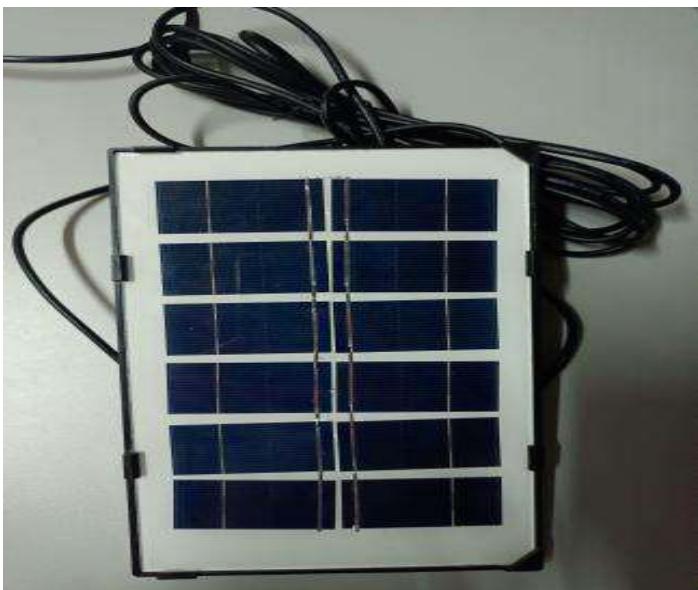
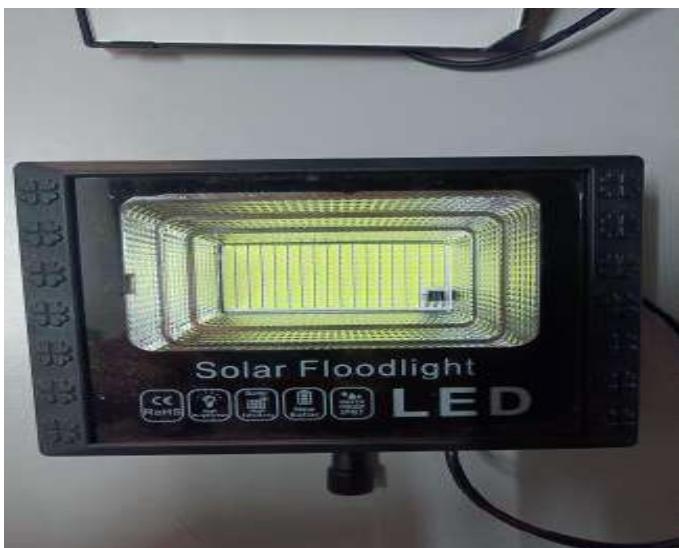
Solar Panel Tracking Light Figure 6: Solar Panel
The practical implications of this paper are as follows:
-
The proposed sensor-based system using a STM32 microcontroller can be implemented in real-time to enhance the efficiency of solar panel tracking.
-
The strategy for analyzing the current and voltage characteristics of a PC due to environmental changes can be used to provide sensor-based feedback for the solar tracking performance strategy.
-
The performance index of MATLAB code was analyzed to achieve optimal results, which can be useful for researchers and engineers working in the field of renewable energy systems.
-
The presented PC panel's tracking strategy using a DC motor and a sensor-assisted system can be used to improve the efficiency of solar photo-voltaic systems.
-
The state-of-the-art reviews of solar photo-voltaic systems analyzed in this paper can be useful for researchers and engineers to understand the current trends and advancements in the field. The performance index of MATLAB code was analyzed to achieve optimal results, which can be useful for researchers and engineers working in the field of renewable energy systems.
Overall, the paper provides practical insights into the use of sensor-based techniques to improve the efficiency of renewable energy systems, specifically solar photo-voltaic systems.
include a LED lamp, solar panels, a battery, a charger, and maybe an inverter, too. Solar panels are used to charge the lamp's batteries, which run on electricity.
III. EXPERIMENTAL SETUP
3.1 Solar LED Lights
Often referred to by the name solar light or solar lantern, solar lamps are lighting systems that
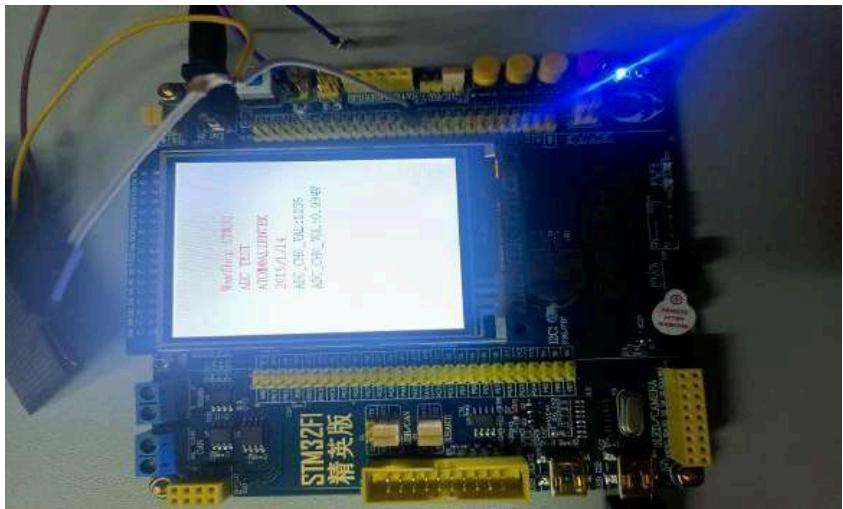
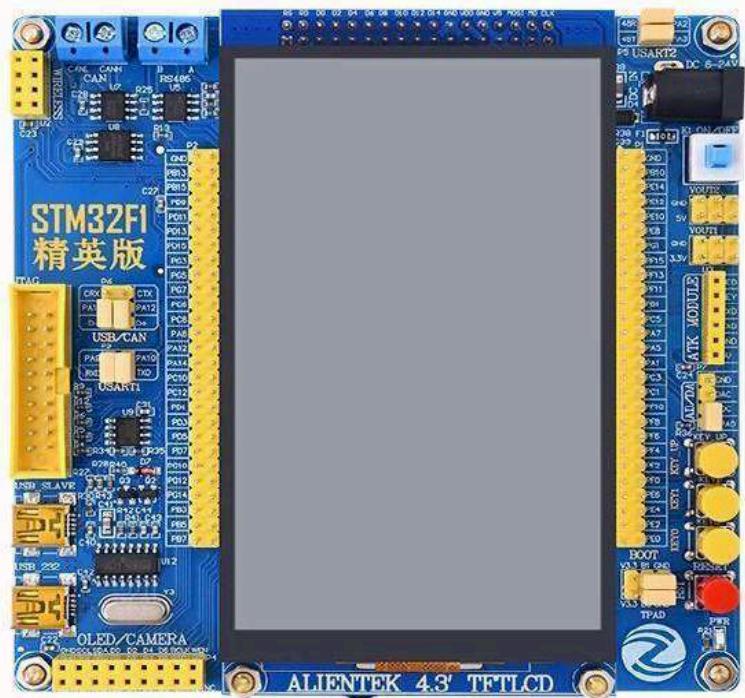
(a) LED of STM32 Microcontroller (b) Digital Controller STM32F1
Tracking Control using Sensor Technology Solar Cell: In Real Time Domain Analysis
(c) Digital Controller connected with PC Figure 7: Overview of the Hardware Setup {"image_source":{"path":"images/cacba67a182ecb21182000ba94767a1fea32185ee72dfb90146413a4b14bebf7.jpg"},"content":"","chart_caption":[{"type":"text","content":"Figure 7 presents the experimental setup of our research. While in Figure 8, presents the Real-time data collection graph. This result is obtained by the following algorithm:"},{"type":"text","content":"Figure 8: Real-time data collection graph"}],"chart_footnote":[]}
The basic parameters of the STM32F1 Elite Edition are as follows:
1. Onboard 16MByte SPI FLASH with large capacity;
-
Onboard EEPROM, infrared, JTAG interface, USB Slave.
-
Provide more than ten kinds of interfaces, which are convenient to connect various modules for development and testing;
-
Onboard 6~24V wide power adapter interface, suitable for common power adapters;
5. With 4.3-inch touch LCD module;
6. Support UCOSII1/LWIP/Fatfs/Emwin.
- The 3.3V/5V power supply/access interface terminal common to the on-board punctuality development board is convenient for external devices and the development board to obtain and supply power from each other.
In the end, we also present the MATLAB code for the data acquisition.
Appendix: (MATLAB Data Acquisition Program)
delete(instrfindall);
s=serial('COM4');
set(s,'BaudRate',115200);
fopen(s);
interval=5000;
passo=1; t=1; x=0;
while(t<interval) b=str2num(fgetl(s));
x=[x,b];
plot(x);
grid t=t+passo;
drawnow; end
VI. CONCLUSION
A PC panel's tracking is described in this paper. Simulink/MATLAB platforms were used to implement the proposed strategy and a sensor-assisted system was examined. This paper proposes a strategy for analyzing the current and voltage characteristics of a PC due to environmental changes. It is analyzed how to provide sensor-based from the PC through the ST's performance strategy. In this article, we analyzed the performance index of MATLAB code for achieving optimal results. We defined the objective function of MATLAB code and specified their constraints. A simulated result is provided in order to determine the PC's efficiency.
Conflict of Interest
The authors declare no conflict of interest.
Ethical Approval
Not applicable
Data Availability
The datasets used in this study are openly available at [repository link] and the source code is available on GitHub at [GitHub link].
Funding
This work did not receive any external funding.
References
Cite this article
Related Research




Special Issue
Launch a focused special issue to highlight research, emerging trends, and expert insights in your academic field.
